


Sometimes audio mixing is done live by an sound engineer or recording engineer, for example at rock concerts and other musical performances where a public address system (PA) is used. A typical concert has two mixers, one located in the audience to mix the front of house speakers heard by the audience, and the other is located at the side of the stage, mixing for the monitor speakers positioned directly in front of the performers so that they can hear one another.
Another example of live mixing is a DJ mixing two records together. Break beats are created by mixing between identical breaks. Often the end of one pre-recorded song is mixed into another so that the transition is seamless, which is done through beat-matching or beat-mixing, and possibly pitch control.
At other times, audio mixing is done in studios as part of multitrack recording in order to produce digital or analog audio recordings, or as part of an album, film or television program.
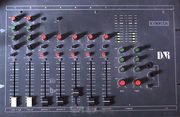 Simple mixing console
An audio mixing console, or mixing desk, or mixing board, has numerous rotating controls (potentiometers) and sliding controls (faders which are also potentiometers) that are used to manipulate the volume, the addition of effects such as reverb, and frequency content (equalization) of audio signals. On most consoles, all the controls that apply to a single channel of audio are arranged in a vertical column called a channel strip. Larger and more complex consoles such as those used in film and television production can contain hundreds of channel strips. Many consoles today, regardless of cost, have automation capabilities so the movement of their controls is performed automatically, not unlike a player piano. A recent trend is to use a "control surface" connected to a computer. This eliminates much of the electronics in a conventional console as the actual mixing work is done digitally by the computer.
Audio mixing on a personal computer is also gaining momentum. More and more independent artists are starting to use their personal computers for digital recording and mixing their work. Audio editing on the computer is also easy and generally preferred.
A recent trend is mixing to 5.1, which is "surround" audio. This requires 6 channels of audio: left, center, right, left rear, right rear, and low frequencies (sub-woofer). In commercial release, only DVD video has a standard. The demand for 5.1 in the audio and music domain was once small but has recently increased dramatically, along with the introduction of 7.1 & 9.1 surround channel audio.